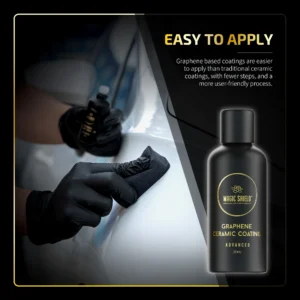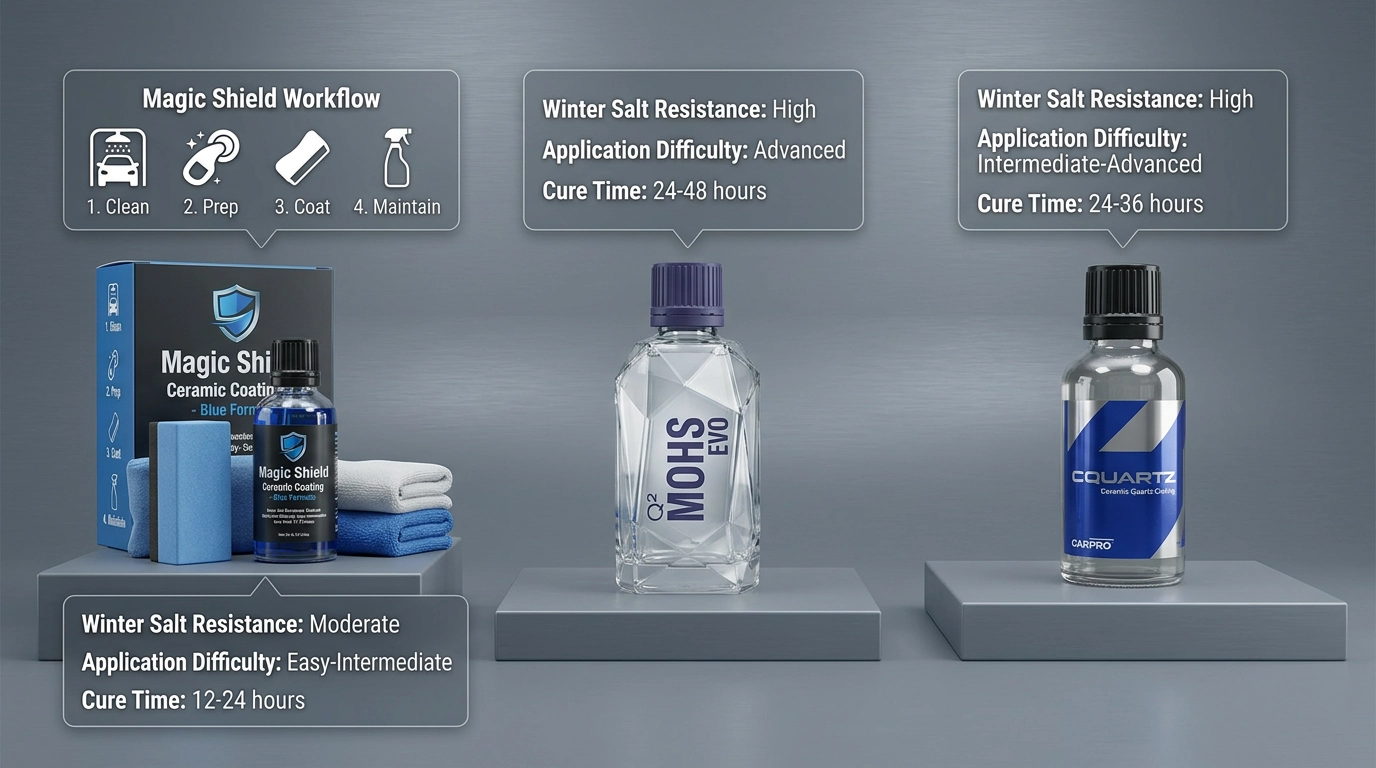
If you’re doing your first DIY coating job in a Canadian winter, Magic Shield’s Clean, Prep, Coat, Maintain system is the clearest path: it gives you a documented cure schedule, a visible flash indicator to check your work, and product guidance that names road salt and winter maintenance directly. GYEON’s Q² lineup offers more product tiers to choose from, and CarPro has the strongest quoted winter language of the three, but neither publishes the hour-by-hour application detail a first-timer needs before touching a spray bottle.
That’s the short answer. Here’s what the research behind it actually shows, and where each brand falls short.
The Three Contenders: What Each Brand Actually Sells
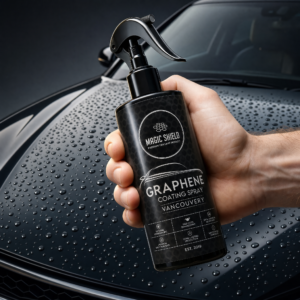
Magic Shield sells two coating products through magic-shield.ca, its Canadian store based in Calgary: Ceramic Coating PRO 10H, a wipe-on coating priced roughly CA$57.99 to $69.99, and Graphene Ceramic Spray, a spray-on maintenance layer priced roughly CA$36.99 to $54.99.
GYEON’s US collection lists five coating tiers: Q² Pure EVO ($59.99-$104.99), Q² Mohs EVO ($64.99-$109.99), Q² One EVO ($62.99-$109.99), Q² Syncro EVO ($109.99-$154.99), and Q² Matte EVO ($104.99). That’s a lot of decisions for someone applying their first coating, and there’s no confirmed Canadian retail pricing for Pure EVO.
CarPro splits its lineup by audience: CQUARTZ Professional (CQ Pro) is positioned for installers, while CQUARTZ Lite 2.0 is marketed for both DIYers and pros, with a tested application range of 10°C to 50°C.
One clarification worth making before comparing durability numbers: graphene isn’t a separate chemistry from ceramic. As Calgary detailer Obsidian Auto explains, a graphene ceramic spray is a ceramic (silicon dioxide) coating infused with a small percentage of graphene oxide, which adds anti-static behavior, better heat dissipation, and a measurable edge in water-spot resistance. That’s why you’ll see coatings from all three brands marketed with “graphene” in the name even though the base chemistry is the same silica network.
The Criteria That Actually Matter for Canadian Conditions
A coating that works fine in Phoenix doesn’t automatically work in Calgary or Winnipeg. Five criteria decide whether a coating holds up here:
- Durability, stated in time and, where available, mileage, using “up to” language since results depend on prep and care.
- Ease of application for someone doing this for the first time: number of steps, a visible flash or “rainbow” cue, and how forgiving the temperature window is.
- Cure time and application temperature, which determine how much of a Canadian winter garage window you actually have.
- Weather resistance, specifically road salt and the calcium/magnesium chloride brine used on Canadian highways, freeze-thaw cycling, and UV oxidation.
- Explicit limits: what the coating cannot do, especially around rock chips and deep scratches.
Comparison Table: Durability, Application, and Weather Resistance
| Product | Durability | Application | Cure Time | Temp Range | Salt/Winter Language | Price |
|---|---|---|---|---|---|---|
| Magic Shield PRO 10H | Up to 2 years (3+ with Spray maintenance) | 5-step wipe-on, rainbow-haze flash cue | 8h initial / 24h before water / 36h full | 15-24°C | FAQ addresses road salt, winter pH-neutral shampoo | CA$57.99-$69.99+ |
| Magic Shield Graphene Ceramic Spray | Up to 12 months | Spray and wipe within 60 seconds | 4h indoor / 24h outdoor / 36h full | Not stated | References road-salt wear | CA$36.99-$54.99 |
| GYEON Q² Pure EVO | Up to 36 months or 40,000 km with maintenance | Single-layer, applicator pad, shade only | 24h minimum, 12h before water | 15-25°C | None on this specific page | €65.75, no confirmed CAD |
| CarPro CQ Pro | Not quantified | Not detailed for DIY | Not stated | Not stated | Reformulated for salt and harsh winters (qualitative) | Not listed |
| CarPro CQUARTZ Lite 2.0 | Up to 2 years | Not detailed for DIY | Not stated | 10-50°C | None on this SKU | Not listed |
Magic Shield’s Clean, Prep, Coat, Maintain Advantage
The named four-step system is the practical difference for a beginner. GYEON and CarPro both describe wash, clay, and polish steps, but neither brands them as a repeatable sequence you can follow the same way every time. Clean, Prep, Coat, Maintain gives you a checklist instead of a paragraph to interpret.
PRO 10H’s rainbow-haze flash cue matters more than it sounds. It’s a built-in error check: apply, wait 3 to 5 minutes, and look for the haze before buffing. Neither CarPro product page documents an equivalent visual cue. That gap shows up in practice: CarCareReviews.net scored Chemical Guys’ Carbon Force only 6.5 out of 10 for ease of use specifically because it “doesn’t flash or rainbow” during application, which raises the risk of streaking for someone doing this for the first time.
The Graphene Ceramic Spray’s job is maintenance, not primary protection. Layer it over a cured PRO 10H coating and you push toward the 3-plus-year range, plus you get a fast option to refresh hydrophobic behavior mid-winter without redoing the full wipe-on process.
GYEON’s Tiered System for Enthusiasts
Q² Pure EVO’s claim of up to 36 months or 40,000 kilometers with maintenance is the longest quantified durability figure in this comparison. But it’s a single-layer, shade-only application with a 12-hour minimum before water exposure, which demands the same controlled garage conditions Magic Shield asks for, just with less margin for error since there’s no second layer to fall back on.
The five-tier lineup (Pure, Mohs, One, Syncro, Matte EVO) is genuinely useful if you know you want a specific hardness or finish. For a first-time DIYer who just wants one clear answer, it’s an extra decision. And with no confirmed Canadian retail price for Pure EVO, you’re comparing costs across currencies before you’ve even bought anything.
CarPro’s Professional-Grade Positioning
CQ Pro carries the strongest quoted winter claim among all three brands. CarPro states the reformulation was driven by installer feedback that “led us to significantly enhancing CQPRO’s ability to endure salty environments and harsh winters, greatly increasing its durability compared to the previous formula.” That’s a real, named claim, but it’s qualitative: no years, no kilometers, no hardness number attached to it.
CQUARTZ Lite 2.0 offers a wider tested temperature window (10°C to 50°C) than Magic Shield’s 15-24°C guidance, which could matter in a garage that swings more than a heated one does. But neither CarPro page states a cure time. If you don’t know how long to wait before driving through slush, you’re guessing, and guessing wrong on cure time is how coatings fail early.
Tradeoffs: Where Each Brand Falls Short
Magic Shield doesn’t publish independent lab data on water-contact angle or a mileage-based durability figure, and PRO 10H is explicitly not scratch-proof: it won’t stop rock chips or fix a failed clear coat.
GYEON’s climate claims (UV resistance, acid rain, salt protection) appear at the collection-page level, not confirmed on the Pure EVO product page itself, and no Mohs hardness numbers are published for it.
CarPro has the best quoted salt/winter language but the least DIY planning detail: no durability number, no temperature range, no cure schedule on the CQ Pro page.
None of the three address undercarriage or wheel-well rust. Ride and Shine Detail notes road salt does its worst damage in “hidden areas like wheel wells, door sills, and the undercarriage, where salt tends to accumulate.” A coating on your visible paint doesn’t reach those zones.
What No Graphene Ceramic Coating Solves
Every product here is subject to the same limit: none is scratch-proof, chip-proof, or self-healing, and durability depends on correct prep, application, cure, environment, and ongoing maintenance.
Obsidian Auto’s Calgary-specific degradation ranking is worth sitting with if you’re deciding how much to invest in prep versus product. Their ranking of stressors by impact: calcium chloride brine spotting (90%), meltwater and slush mineral spots (84%), automatic wash micro-marring (76%), freeze-thaw cycling (58%), and UV oxidation (34%). Notice that the top two stressors are both about washing habits and mineral exposure, not the coating chemistry itself. That’s the insight most comparison pages miss: your winter wash routine affects outcomes more than which coating you pick.
Jimbo’s Detailing makes a similar point about marketing: “additives don’t guarantee better performance,” and prep, resin quality, and real-world care outweigh graphene marketing alone.
And none of these coatings stop rock chips. In a gravel-and-sand city, the layer that protects against stone impact is paint protection film (PPF) on the impact zones, applied separately from any ceramic or graphene coating.
Which Coating Fits Your Situation
Pick Magic Shield PRO 10H plus Graphene Ceramic Spray if you’re applying your first coating in a province with heavy road salt and want a documented, hour-by-hour cure schedule with a built-in flash check.
Pick GYEON Q² Pure EVO if the 36-month/40,000-kilometer figure matters most to you, you’re comfortable with a single-layer, shade-only application, and you can work around the CAD pricing gap.
Pick CarPro CQUARTZ Lite 2.0 if your garage swings wider in temperature and you don’t need a published cure-time figure to plan around.
Pick CarPro CQ Pro only if you’re a professional installer or working alongside one; its salt and winter claim is real, but the page isn’t built for a DIY first attempt.
If you’re gearing up for your first coating and want the road salt, freeze-thaw, and UV cycle handled with a process you can actually follow start to finish, start with Magic Shield’s Clean, Prep, Coat, Maintain kit on magic-shield.ca, and check the application instructions on the product page before you open the bottle.