About this guide: Magic Shield is a Canadian online store for do-it-yourself car-care products. This guide explains what a professional nano ceramic coating involves and how to get similar results yourself with products such as Diamond AI Coating, the Graphene Ceramic Coating Kit and the prep products in our preparation range. Not sure where to start? Try the Product Finder.
Table of Contents
If you type nano ceramic coating near me into Google, you’re probably there, in your driveway, looking at road salt smudges, a faded clear coat, or a brand new car you really want to keep safe before winter starts. Here’s the plain answer: a pro-grade nano ceramic coating is one of the better ways to guard Canadian car paint from UV rays, oxidation, road salt, bird droppings, tree sap, and those annoying water spots—and you do not always have to go driving across town to get it. Magic Shield brings dealer quality nano ceramic coating for cars to Canadians right at their own driveways, whether you book a local certified installer , or you use a pro-grade DIY kit yourself this weekend.
In this guide we’re going to zoom in on what nano ceramic coating actually is, how well it handles Canada’s wild seasonal swings, how to check the “nano ceramic coating near me” providers around you, and how Magic Shield’s solutions stack up versus older paint protection ideas like waxes and sealants.
What is nano ceramic coating?
Nano ceramic coating is basically a liquid polymer system, made with silicon dioxide (SiO2) and titanium dioxide (TiO2) nanoparticles, that chemically bonds to the clear coat instead of just hanging out on top. After it cures,nano ceramic coating near me it turns into a hard, glass like, hydrophobic layer. It’s measured in microns, but it behaves like a protective barrier: it pushes water away, helps slow down UV damage, and gives you a smoother surface where dirt, salt, and grime don’t cling as easily. That bonding concept is the whole point behind most nano ceramic coating for cars products, including Magic Shield’s own formulas.
How nano ceramic coating differs from wax and sealants
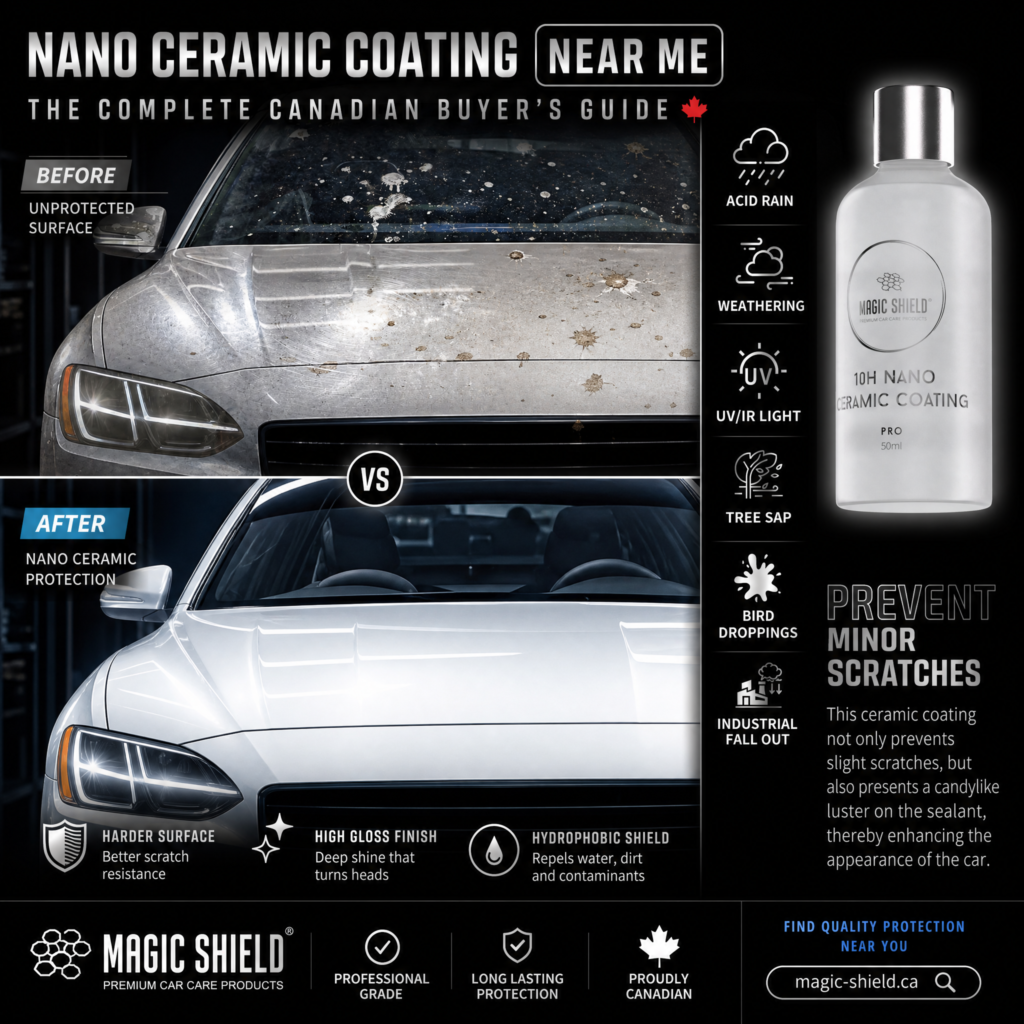
Carnauba wax stays on the surface of the clear coat and it tends to break down within weeks, especially if you’re in intense sun or getting heavy rain back to back. Paint sealants last a bit longer thanks to synthetic polymers, but they still wear down
Why Canadian car owners need nano ceramic coating
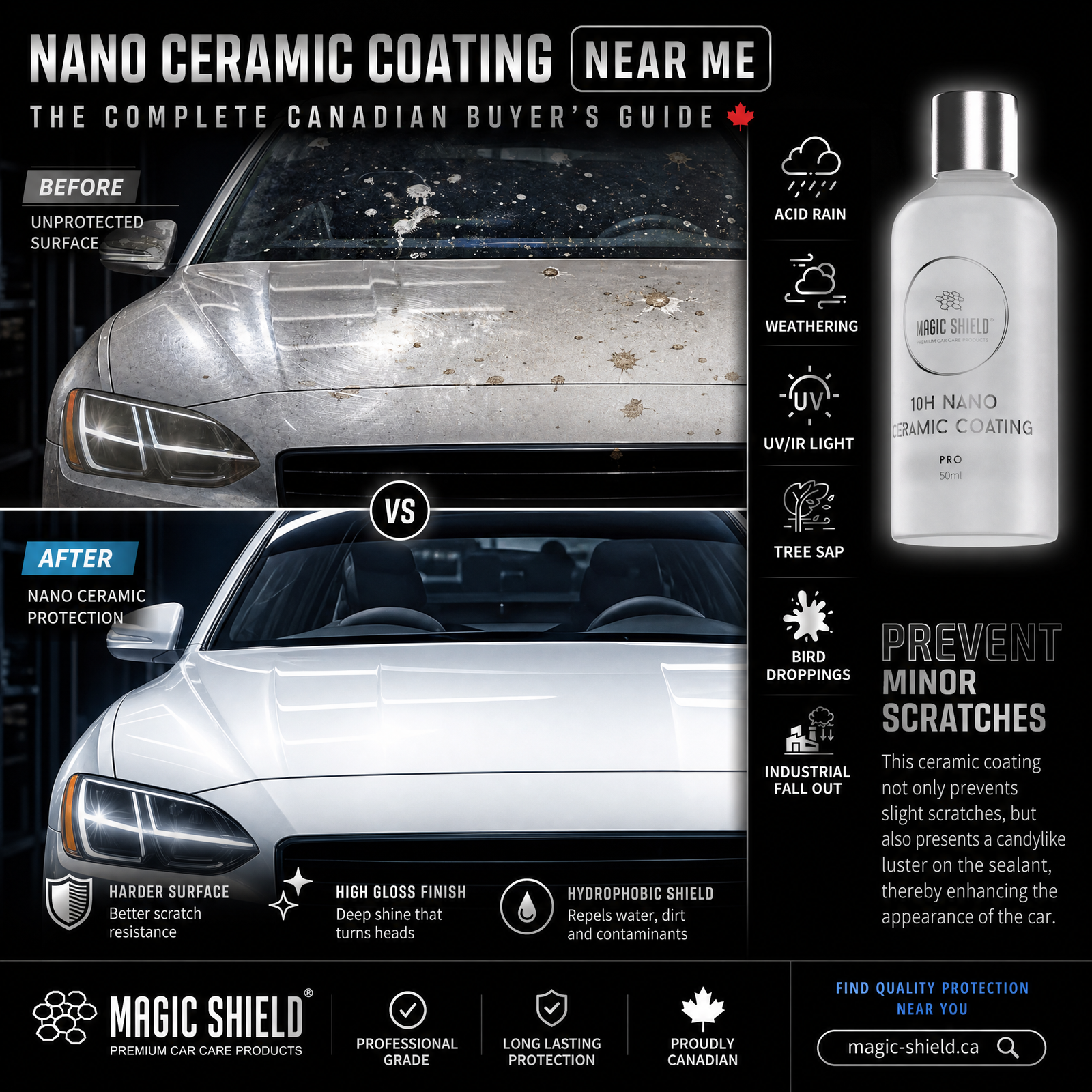
Canadian car owners really need a nano ceramic coating, because the weather here is just kinda relentless, and your clear coat doesn’t get a break. In Canada we’ve got that mix of prairie sun and humid coastal air, then on top of that, de-icing salt on almost every road from October to April. So the paint is constantly getting hit by UV and chemicals, day after day, not just “sometimes”. And a hydrophobic ceramic coating handles those problems in a pretty direct way.
First off, UV rays and paint oxidation
Long bright summer stretches across the country mean your vehicle sits in direct UV for hours, which slowly weakens the resins inside the clear coat. That’s how you end up with fading, chalky oxidation, and a finish that looks dull even if the car is still clean. With a nano ceramic layer, it works like a sacrificial UV barrier, absorbing plus reflecting a big portion of the radiation before it reaches the paint underneath. So the color stays deeper, and the gloss keeps its “fresh” look for longer.
Then road salt and winter corrosion
In Ontario, Quebec, and the Prairies, municipalities use a lot of road salt and brine every winter to keep highways safe. But that stuff is corrosive, and if you don’t have protection, it can etch into the clear coat over a season. When a coating is properly cured, it becomes hydrophobic and chemically tougher, so the salt brine tends to bead up and basically slide off, instead of clinging to the surface like a stubborn film. And whatever residue does manage to stick, it usually rinses away more easily during a quick winter wash, so you don’t keep dragging the same grime back onto the paint.
Also bird droppings and tree sap
Bird droppings and tree sap both have acidic properties, and they can etch into bare clear coat fairly quickly, especially if your car parks under trees at work, or in a driveway where migratory birds hang around. A ceramic layer slows down the chemical bonding, so you get a little more time to wipe the spot off before it turns into a permanent stain, or at least before you see that dull ring, halo, sort of effect on the paint.
Water spots and hard water etching
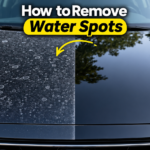
A lot of car owners in Canada deal with hard water, meaning the supply has a bigger mineral content. If you leave the water to air-dry on a hood or roof, those minerals can dry into a chalky-looking residue, and it can nano ceramic coating near me etch into unprotected paint. Coated paint sheets water off in bigger beads instead of letting it sit, pool, and evaporate slowly. That shift is what makes water spotting drop a lot.
Scratches, swirl marks and everyday wear
Nothing coated is totally scratch-proof , but nano ceramic layers do give real surface hardness. So you get more resistance against the faint swirl marks and the tiny micro-scratching that often shows up nano ceramic coating near me from automatic car washes, dust wiping, and just normal brushby contact. Also, the smoother feel—like a slick surface that kind of shrugs off abrasive grit before it can be dragged across the clear coat—helps cut down the fine scratches that usually dull the look of paint as time passes.
Quick answer for busy readers: nano ceramic coating protects Canadian car paint by building a hard hydrophobic UV resistant barrier. It works against oxidation, road salt corrosion, bird dropping and tree sap etching, water spots, and minor surface scratching, pretty much all at once.
Key benefits of nano ceramic coating
- Deep, glass-like gloss that makes even a five-year-old vehicle look freshly detailed.
- Long-lasting ceramic coating protection measured in years, not weeks, reducing how often you need to reapply anything.
- Easier cleaning because dirt, salt, and mud have far less to grip onto.
- Stronger UV and chemical resistance that helps preserve resale value by keeping the original paint healthier for longer.
- Reduced water spotting thanks to aggressive hydrophobic beading and sheeting.
- Better protection against Canadian road salt compared with an unprotected or wax-only finish.
See the difference on your own paint
Magic Shield’s ceramic coating kits are formulated and tested for Canadian winters, summers, and everything in between.
How to find the best nano ceramic coating near you, kinda fast
If you search “ceramic coating near me” you usually get a jumble of mobile detailers, dealership add-on deals, and dedicated coating studios, and yeah the results can be all over the place. When you’re thinking about booking anyone for car ceramic coating Canada-wide, don’t just go by the first ad, instead check a few specific points, really.
First, ask them what exact product line they use and what the SiO2 concentration is. “Ceramic” by itself is a too general label, you want the real numbers.
Second, request a written warranty that actually states the coating tier. Not some vague “lifetime shine” brag, with nothing named.
Third, try to find before and after photos you can verify, ideally on the same panel, in consistent lighting. If the images look cherry-picked or basically incomparable, that’s a yellow flag.
Fourth, read newer Canadian reviews, because climate specific performance matters more than a high star rating that was given once, like forever ago.
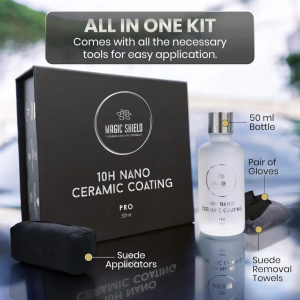
If a certified installer near you is fully booked, too pricey, or simply not around in your town, a pro-grade DIY path can help. Magic Shield sends a top ceramic coating option to Canada customers who can apply at home, straight to your door, so “nano ceramic coating near me” starts meaning your own garage, not some waitlist across town.
Also, don’t ignore timing. People offering nano ceramic coating near me often book up quickest in spring, right after winter road salt has done its thing, and before summer road trips start rolling. So if you care about a specific date, plan a few weeks ahead for a professional install. But if your schedule doesn’t match the local calendar, the Magic Shield kit lets you protect your paint on your own schedule, any weekend, all year round.
Step by step nano ceramic coating app lication process
First wash and decontaminate, use a pH-neutral car shampoo, then follow with an iron fallout remover to strip inbedded brake dust and that road grime which just clings on.
Clay bar the surface. You’ll want to run a detailing clay bar across every panel, just to lift those bonded contaminants the wash perhaps missed. The idea is to leave the paint feeling almost glass smooth, not sticky.
Polish if it needs it. If there are swirl marks then machine polish or hand polish them out, because the ceramic coating kind of locks in whatever finish is under it, so no shortcuts here.
Wipe down with isopropyl alcohol. This cuts away polishing oils so the coating can bond straight to bare clear coat, nano ceramic coating near me not to residue.
Apply the coating in small sections. Do it one panel at a time with the supplied applicator, ideally in shade and a dust free area, not under direct sun or hot panels.
Level and buff. Remove the excess with a clean microfiber towel, but do it inside the product’s own flash time, otherwise you can get high spots that are a pain later.
Let it cure. Keep the car dry and undriven in rain for the first 24 to 48 hours, then avoid washing for seven to ten days while it fully hardens and settles.
Ceramic coating maintenance tips
- Wash with a dedicated pH-neutral, ceramic-safe shampoo instead of dish soap or generic detergent.
- Avoid automatic tunnel car washes with abrasive brushes; touchless or hand washes preserve the coating longer.
- Rinse off winter road salt regularly rather than letting it sit for weeks at a time.
- Use a dedicated ceramic booster spray every few months to refresh hydrophobic performance between full applications.
- Dry panels with a clean, soft microfiber towel instead of air-drying, to prevent water spotting.
- Reapply or top up your long-lasting ceramic coating as recommended, typically every one to two years for DIY tiers.
Common ceramic coating mistakes to avoid
Applying coating over paint that has not been properly clay-barred and decontaminated, which traps grit under the layer.
Working in direct sunlight or high humidity, which causes the product to flash and cure unevenly before it can be leveled.
Applying too much product per panel, leaving visible high spots or streaking once cured.
Washing the vehicle before the recommended cure window has fully passed.
Expecting a coating to prevent every scratch, when it primarily resists light swirling and chemical etching.
Skipping paint correction on visibly swirled paint, which locks existing imperfections in under a glossy layer.
Why choose Magic Shield for ceramic coating in Canada
Magic Shield formulates every coating specifically with Canadian conditions in mind, rather than repackaging a generic global formula. That means nano ceramic coating near me accounting for freeze-thaw cycles, heavy winter road salt, and the intensity of prairie and coastal summer sun in the same product line. Whether you want a ceramic coating for new cars straight off the lot or a refresh for a daily driver that has already seen a few Canadian winters, Magic Shield’s kits are built to perform in exactly the conditions you actually drive in.
Beyond the formula itself, nano ceramic coating near me Magic Shield backs every kit with clear application instructions, transparent ingredient and durability information, and Canadian-based customer support, so you are never guessing whether a product marketed elsewhere will actually hold up here.
So when you next search nano ceramic coating near me, remember that “near me” no longer has to mean the closest detail shop with an opening in three weeks. It can mean the kit already on its way to your address, backed by a brand built specifically for Canadian roads, Canadian winters, and Canadian car owners.
Ready to protect your paint the Canadian way
Get the same hydrophobic, UV-resistant protection nano ceramic coating near me professional installers use, shipped straight to your door.
FAQs:
How long does nano ceramic coating last ?
A professionally applied nano ceramic coating usually lasts about two to five years, while a well cared for DIY nano ceramic coating near me, can often last one to three years depending on SiO2 level , the number of layers, and also how the vehicle is parked, and cleaned.
Is nano ceramic coating worth it in Canada ?
A professionally applied nano ceramic coating usually lasts about two to five years, while a well cared for DIY nano ceramic coating, can often last one to three years depending on SiO2 level , the number of layers, and also how the vehicle is parked, and cleaned.
Can I apply nano ceramic coating myself?
Yes. DIY kits like Magic Shield’s are built for home use with a clear set of steps, but the final look depends on thorough decontamination , working on the right panel sections, and giving it enough cure time, before normal driving rain and washing.
Does ceramic coating stop scratches completely ?
No , not really. It helps with light swirl marks and small surface scuffs, but it wont stop deep damage from keys, gravel impacts, or rough washing mistakes. So gentle habits still matter.
How soon can I wash my car after ceramic coating ?
Most coatings need roughly seven to ten days to fully cure, and the car should avoid water, rain, or any washing during that window so the layer can actually bond right.
Is Magic Shield ceramic coating good for new cars ?
Yes. If you apply nano ceramic coating when the paint is fresh, smooth, and defect free , it helps lock in that factory gloss and reduces early oxidation, road salt assault, and UV dulling before the clear coat starts to weaken.
Also Read:
Black Diamond Coatings | Premium Ceramic Protection | Magic Shield